How to learn katakana when you already know hiragana
7 min read
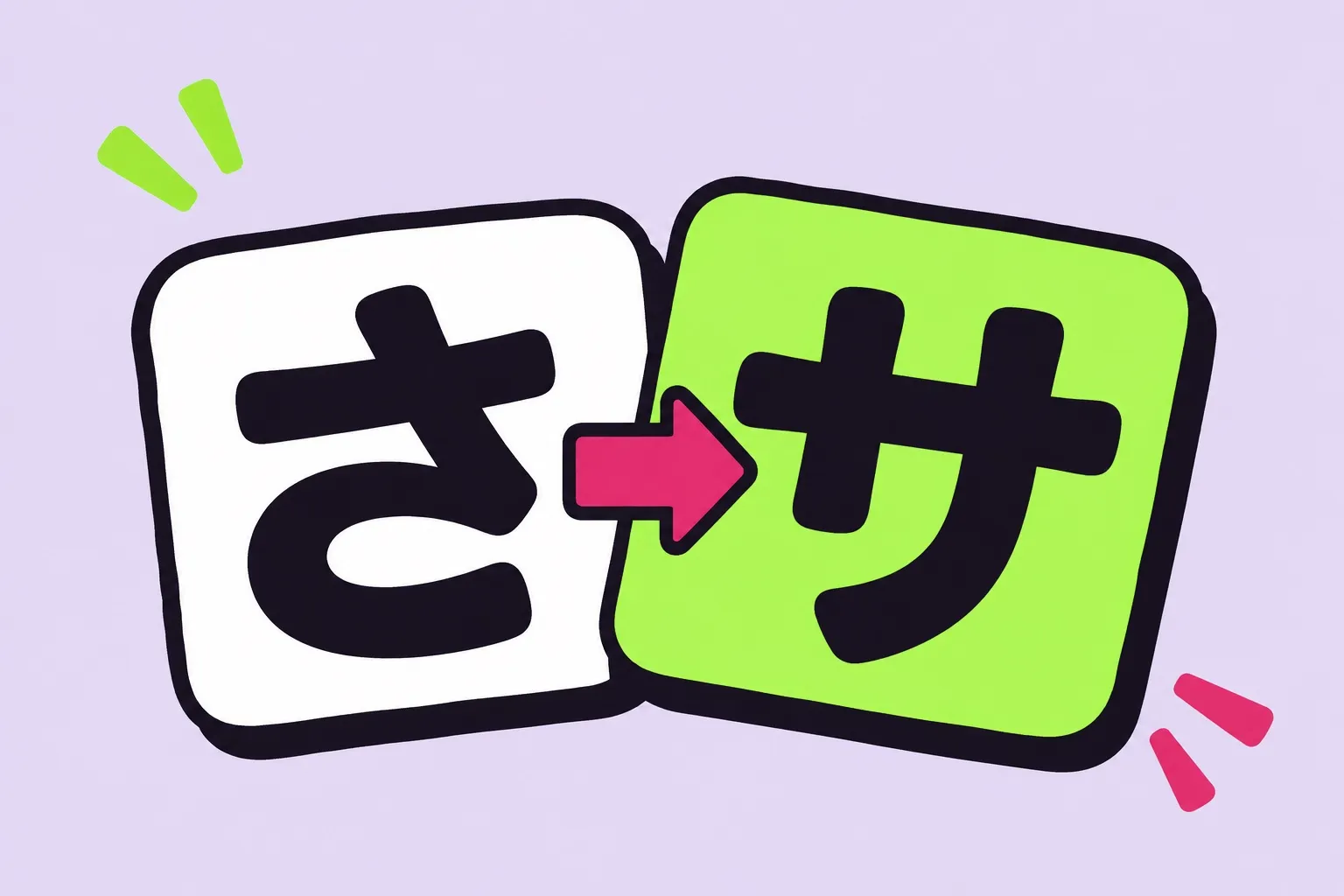
If you can read hiragana, you already know half of katakana. The sounds are the same, the rows are the same, and dakuten and small characters work the same way. What's new is the shapes, plus a few extras for words Japanese borrowed from other languages.
There are 46 basic katakana, one for each of the 46 hiragana. Add the 25 with dakuten marks (ガ, パ and the rest) and combinations like キャ, and you get just over 100. All of them are built from those 46 shapes.
What carries over from hiragana
Everything except the shapes. カ is ka, just like か. The chart runs in the same order (a, ka, sa, ta, na, ha, ma, ya, ra, wa), so you can learn it row by row the way you learned hiragana. Dakuten turn カ into ガ the same way they turn か into が. Small ャ ュ ョ make キャ, シュ and チョ the same way they make きゃ, しゅ and ちょ.
So you aren't learning a second writing system. You're learning new shapes for sounds you already know. The katakana chart has all of them on one page.
The ones you can already read
Some katakana look so much like their hiragana pair that you can read them on sight:
| Katakana | Hiragana | Sound |
|---|---|---|
| カ | か | ka |
| キ | き | ki |
| セ | せ | se |
| ヘ | へ | he |
| モ | も | mo |
| ヤ | や | ya |
| リ | り | ri |
That's seven characters before you've studied anything, and the rest of the chart gets smaller.
One pair works against you. サ is sa, but it looks a lot like hiragana せ, which is se. So when you see サ, your hiragana habit says se. It's sa. And the katakana that really is se, セ, also looks like せ. The fix is to see all four side by side: quiz the sa row in both scripts and さ, せ, サ and セ come up together until you stop mixing them up.
Look-alikes inside katakana
Katakana is made of short, straight strokes, so some characters differ by one stroke or by the angle of a line. These are the pairs that get mixed up.
シ (shi) and ツ (tsu)
Both are two dashes and a long stroke. Check where the dashes sit and which way the long stroke goes.
- シ (shi): the dashes are stacked on the left and lie flat. The long stroke sweeps up from the bottom left.
- ツ (tsu): the dashes sit side by side along the top and stand upright. The long stroke falls from the top right down to the left.
ソ (so) and ン (n)
The same rule with one dash instead of two.
- ン (n): a flat dash on the left, and a long stroke that sweeps up. Like シ.
- ソ (so): an upright dash on top, and a long stroke that falls down. Like ツ.
If you remember one thing: シ and ン sweep up, ツ and ソ fall down. You feel that difference in your hand when you write them, so these four are worth writing out a few times.
ク (ku), ケ (ke) and タ (ta)
- ク (ku): a short stroke, then a line that goes right and bends down to the left. This is the base shape.
- タ (ta): ク with a short dash inside.
- ケ (ke): the top line runs straight out to the right and doesn't bend. The last stroke drops from the middle of it.
ワ (wa), ウ (u) and フ (fu)
Each one adds a stroke to the one before.
- フ (fu): one stroke, across and down.
- ワ (wa): フ with a short line on the left, like a lid.
- ウ (u): ワ with a dash on top. It also looks like hiragana う, which helps.
ス (su) and ヌ (nu)
Both start with the same stroke, across and down to the left. The second stroke decides it.
- ス (su): the short stroke starts on the curve and points down to the right. It touches the curve but doesn't cross it.
- ヌ (nu): the short stroke cuts across the curve.
This quiz puts シ, ツ, ソ, ン and タ in one set. For the rest, quiz all 46 and every pair turns up.
An order that works
1. Rows, two at a time. Start with the ア and カ rows, then サ and タ, then ナ and ハ, then マ ヤ ラ ワ. Move on when you can read a pair of rows without stopping to think. I built Kana Dash so you can quiz just the rows you've reached, and this is the stage where that matters most.
2. The look-alikes. Once all 46 are in, quiz them together and notice which ones you miss. They'll almost always come from the pairs above. Go back to those rows, or write them out.
3. Dakuten and combinations. If you know hiragana, there's nothing new to learn here, only new shapes to recognize. Do dakuten first, then combinations.
4. The long vowel mark, small ッ and borrowed sounds. These show up far more in katakana than in hiragana, so they get their own section below.
5. Real words. Knowing every character isn't the same as reading. That part comes from words, covered at the end.
If you'd rather follow fixed steps with a quiz link for each, the free kana course covers katakana in steps 9 to 14.
The long vowel mark, small ッ and borrowed sounds
The long vowel mark ー makes the vowel before it long. Hiragana writes a long vowel with an extra vowel character, as in おかあさん (okāsan). Katakana uses a dash instead: コーヒー (kōhī, coffee), ケーキ (kēki, cake), スーパー (sūpā, supermarket).
Small ッ doubles the consonant after it, just like small っ does in hiragana: ベッド (beddo, bed), カップ (kappu, cup), チケット (chiketto, ticket).
Borrowed sounds fill gaps. Japanese has no ti, fa or wi of its own, so katakana writes them as a normal character plus a small vowel: ティ (ti), ファ (fa), ウィ (wi). You'll see them in words like パーティー (pātī, party), ファイル (fairu, file) and ハロウィン (harowin, Halloween). This quiz has only the borrowed sounds.
Read real words
The rows teach you to sound out katakana. Words teach you to read it. Most katakana words are loanwords, and many come from English, so once you sound one out you can often guess it: テレビ (terebi, TV), ホテル (hoteru, hotel), タクシー (takushī, taxi), アイスクリーム (aisukurīmu, ice cream).
Say the word out loud, then say it again faster and drop the extra vowels. Ho-te-ru sounds odd until you hear "hotel" in it. Not every loanword is English, though. パン (pan, bread) comes from Portuguese, and アルバイト (arubaito, part-time job) from German.
Look for katakana anywhere you'd find Japanese: a café menu, a shop's website, the back of a snack packet. A good first word is your own name in Japanese, since foreign names are written in katakana and you already know how yours should sound.
Real text switches between scripts mid-sentence, so once both feel solid, mix hiragana and katakana in one quiz. That's where せ and サ get tested properly. The hiragana vs katakana guide explains when Japanese uses each one.
How long it takes
There's no number that holds for everyone. It does go faster than hiragana did, because the sounds are already done and you're only learning shapes. With ten minutes a day, getting through the rows usually takes less time than hiragana took you.
The look-alikes take longer to settle, and reading whole words at speed takes longest. Don't be surprised if katakana stays slower than hiragana for months. You see it less often, and the words are long. More reading closes that gap faster than more drilling.
If writing helps you remember, print a stroke order chart or practice writing katakana in the browser.