Dakuten, handakuten and small tsu: the marks that change kana
8 min read
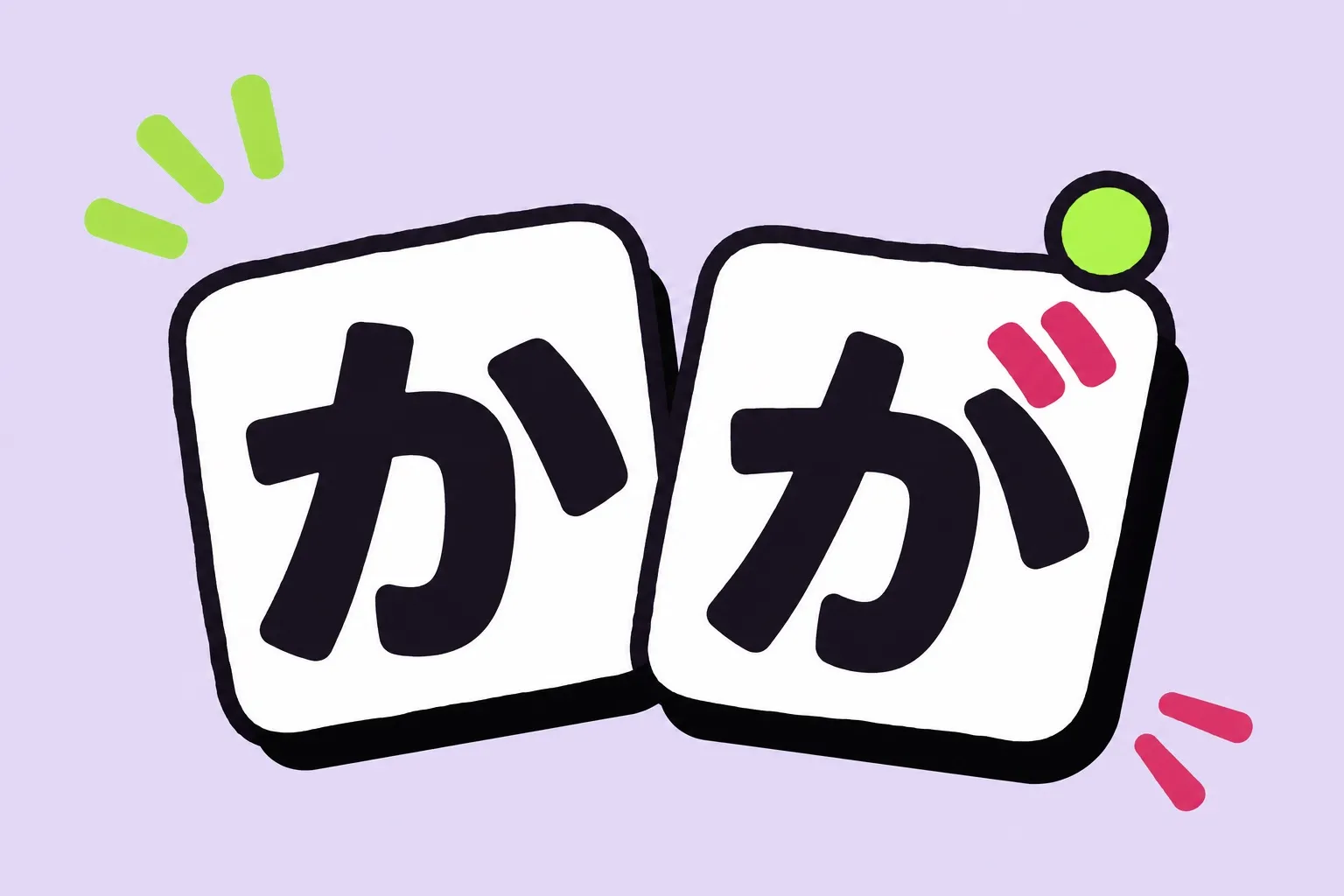
Once you know the 46 basic hiragana, a few small marks unlock most of the sounds that are left. Two strokes in the corner turn か ka into が ga. A small circle turns は ha into ぱ pa. A small っ doubles the next consonant, and a small ゃ, ゅ or ょ squeezes two kana into one sound. None of them adds a new shape to learn. They change kana you already read.
What is a dakuten?
The dakuten ゛ is the pair of short strokes at the top right of a kana. It makes the consonant voiced, so your throat buzzes as you say it: k becomes g, s becomes z, t becomes d and h becomes b. It only goes on four rows, and it can change a word completely: かき kaki is a persimmon, かぎ kagi is a key.
| Base | With dakuten | Romaji | Practice |
|---|---|---|---|
| か き く け こ | が ぎ ぐ げ ご | ga gi gu ge go | Quiz |
| さ し す せ そ | ざ じ ず ぜ ぞ | za ji zu ze zo | Quiz |
| た ち つ て と | だ ぢ づ で ど | da ji zu de do | Quiz |
| は ひ ふ へ ほ | ば び ぶ べ ぼ | ba bi bu be bo | Quiz |
Practice all four rows together in one dakuten quiz.
Katakana works the same way, with the same marks in the same place: カ ka, ガ ga. Once you can read が, you can read ガ.
Dakuten or tenten?
They're the same mark. Dakuten (濁点) is the proper name, and it means "muddy mark". In everyday Japanese, people call it tenten (点々), "dot dot", or just ten-ten. If a Japanese friend tells you to add tenten, add the dakuten.
Dakuten vs dakuon
The dakuten is the mark. Dakuon (濁音) is the sound it makes, the voiced g, z, d and b. You'll see dakuon in textbooks and dakuten everywhere else, and for reading kana the difference doesn't matter.
What is a handakuten?
The handakuten ゜ is a small circle in the same corner. Its name means "half-muddy mark", and people often call it maru, "circle". It only goes on the h row, and turns h into p.
| Base | With handakuten | Romaji | Practice |
|---|---|---|---|
| は ひ ふ へ ほ | ぱ ぴ ぷ ぺ ぽ | pa pi pu pe po | Quiz |
The h row is the only row with two marks, so ば ba and ぱ pa are worth checking twice. Strokes mean b, a circle means p.
じ vs ぢ and ず vs づ
ぢ is ち chi with a dakuten, and it doesn't sound like "di". In modern Japanese it's pronounced ji, the same as じ. づ sounds like zu, the same as ず. So how do you know which one a word uses?
Almost always it's じ and ず. You'll meet ぢ and づ in two places:
- When two words join and the second one starts with ち or つ. はな (nose) and ち (blood) make はなぢ hanaji, a nosebleed. みか and つき (moon) make みかづき mikazuki, a crescent moon.
- When the same sound repeats, as in ちぢむ chijimu (to shrink) and つづく tsuzuku (to continue).
To type them, write di for ぢ and du for づ. Typing ji and zu gives you じ and ず. The guides to typing Japanese on a Mac and on Windows cover the rest.
Why ヴ exists
Japanese has no v sound, so loanwords used to swap it for b: バイオリン baiorin, violin. ヴ is ウ u with a dakuten, made for spelling v. Combined with small vowels it gives ヴァ va, ヴィ vi, ヴェ ve and ヴォ vo, so you'll see violin spelled ヴァイオリン too. Most people still say it with a b, and both spellings are correct. ヴ lives in katakana. The hiragana version ゔ exists but you'll rarely see it.
You'll also see dakuten in places they aren't supposed to go. Manga puts them on vowels, like あ゛, for a strangled or gravelly scream. That's sound effects, not spelling, so don't worry about reading them as anything in particular.
How small tsu doubles a consonant
A small っ (katakana ッ) is called sokuon. It has no sound of its own. It tells you to hold the next consonant for an extra beat, a tiny pause before you release it. In romaji, you write it by doubling that consonant.
| Kana | Romaji | Meaning |
|---|---|---|
| きって | kitte | stamp |
| がっこう | gakkou | school |
| ざっし | zasshi | magazine |
| まっちゃ | matcha | matcha |
| ベッド | beddo | bed |
Size matters. きって kitte is a stamp, and きつて with a full-size つ would be read ki-tsu-te. Before ch, romaji writes the double as tch, which is why まっちゃ is matcha and not maccha. At the end of a word, as in あっ, it cuts the sound off short, like a startled "ah!".
To type a small っ, double the next letter (kitte), or type ltu or xtu on its own.
Small ゃ, ゅ and ょ: combination kana
Put a small ゃ, ゅ or ょ after a kana from the i column (き し ち に ひ み り and their dakuten versions), and the two blend into one sound. These are called yōon, or combination kana.
| Base | + ゃ ゅ ょ | Romaji | Practice |
|---|---|---|---|
| き | きゃ きゅ きょ | kya kyu kyo | Quiz |
| し | しゃ しゅ しょ | sha shu sho | Quiz |
| ち | ちゃ ちゅ ちょ | cha chu cho | Quiz |
| に | にゃ にゅ にょ | nya nyu nyo | Quiz |
| ひ | ひゃ ひゅ ひょ | hya hyu hyo | Quiz |
| み | みゃ みゅ みょ | mya myu myo | Quiz |
| り | りゃ りゅ りょ | rya ryu ryo | Quiz |
The same works with the dakuten and handakuten versions:
| Base | + ゃ ゅ ょ | Romaji | Practice |
|---|---|---|---|
| ぎ | ぎゃ ぎゅ ぎょ | gya gyu gyo | Quiz |
| じ | じゃ じゅ じょ | ja ju jo | Quiz |
| び | びゃ びゅ びょ | bya byu byo | Quiz |
| ぴ | ぴゃ ぴゅ ぴょ | pya pyu pyo | Quiz |
Practice every row in one combination quiz.
Here too, the size of the second kana changes the word. びょういん byōin is a hospital. びよういん biyōin is a hair salon. Not a mix-up you want to make on the phone.
Katakana gets a few extra
Katakana uses every mark above, and adds small vowels ァ ィ ゥ ェ ォ to spell sounds Japanese borrowed from other languages: ファ fa, ティ ti, ウィ wi, チェ che. You'll see them on menus and in names, like パーティー pātī (party) or フォーク fōku (fork). The hiragana vs katakana guide explains when each script is used.
Practice them with the katakana dakuten quiz and the katakana combination quiz, which includes the borrowed sounds.
Dakuten and combination chart
Everything above on one chart, in hiragana with katakana beside it. Use it with the full hiragana chart and katakana chart for the base kana.
| Row | Hiragana | Katakana | Romaji |
|---|---|---|---|
| G | が ぎ ぐ げ ご | ガ ギ グ ゲ ゴ | ga gi gu ge go |
| Z | ざ じ ず ぜ ぞ | ザ ジ ズ ゼ ゾ | za ji zu ze zo |
| D | だ ぢ づ で ど | ダ ヂ ヅ デ ド | da ji zu de do |
| B | ば び ぶ べ ぼ | バ ビ ブ ベ ボ | ba bi bu be bo |
| P | ぱ ぴ ぷ ぺ ぽ | パ ピ プ ペ ポ | pa pi pu pe po |
| KY | きゃ きゅ きょ | キャ キュ キョ | kya kyu kyo |
| SH | しゃ しゅ しょ | シャ シュ ショ | sha shu sho |
| CH | ちゃ ちゅ ちょ | チャ チュ チョ | cha chu cho |
| NY | にゃ にゅ にょ | ニャ ニュ ニョ | nya nyu nyo |
| HY | ひゃ ひゅ ひょ | ヒャ ヒュ ヒョ | hya hyu hyo |
| MY | みゃ みゅ みょ | ミャ ミュ ミョ | mya myu myo |
| RY | りゃ りゅ りょ | リャ リュ リョ | rya ryu ryo |
| GY | ぎゃ ぎゅ ぎょ | ギャ ギュ ギョ | gya gyu gyo |
| J | じゃ じゅ じょ | ジャ ジュ ジョ | ja ju jo |
| BY | びゃ びゅ びょ | ビャ ビュ ビョ | bya byu byo |
| PY | ぴゃ ぴゅ ぴょ | ピャ ピュ ピョ | pya pyu pyo |
If you're working through the free kana course, these are steps 7 and 8 for hiragana and 13 and 14 for katakana.